Quick answer
If a carbon monoxide alarm goes off near your furnace, get everyone out, including pets, and call 911 or your gas utility from outside. Stay out until responders clear the house. Then keep the furnace off until a technician performs a combustion analysis and checks the heat exchanger, flue and water heater draft to find the cause.
A sounding CO alarm is never a false alarm until a professional proves it. Here is exactly what to do, what usually causes furnace carbon monoxide, and how to prevent a repeat.
If your carbon monoxide alarm is sounding, get every person and pet out of the house now, leave the door open behind you, and call 911 or your gas utility from outside. Do not stop to find the source, open windows room by room or shut off the furnace first. Carbon monoxide has no smell or color, and minutes matter.
Once the fire department or utility has cleared the home, the next job is finding out why it happened. In a heating season, the furnace, water heater and venting are the first places we look.
Sounding alarm vs. chirping alarm
A continuous pattern of four quick beeps is the carbon monoxide alarm. A single chirp every minute or so almost always means a low battery or an end-of-life warning. Most CO alarms are built to last only several years, so check the manufacture date printed on the back. When in doubt, treat it as a real alarm and get out.
How a furnace produces carbon monoxide
A gas furnace that is burning cleanly and venting properly makes very little CO, and what it does make goes up the flue. Trouble starts when combustion goes bad or exhaust gets pushed back into the living space.
Cracked or rusted heat exchanger
The heat exchanger is the metal wall between burning gas and the air you breathe. Years of heating and cooling can crack it, especially on furnaces that have been starved for airflow. A crack lets combustion byproducts mix into the supply air or disturbs the flame enough to produce CO.
Blocked or disconnected venting
Bird nests, a collapsed clay chimney liner, a sagging flue pipe that pulled loose from the draft hood, or snow drifted over a PVC exhaust can all send exhaust back into the house. A common situation in older Montgomery County homes is a gas water heater left alone in an oversized masonry chimney after the furnace was upgraded, which can cause poor draft and backdrafting.
Poor combustion
Dirty burners, incorrect gas pressure or a shortage of combustion air in a tight utility closet can all make a furnace burn rich. A lazy yellow flame instead of a crisp blue one is a visible clue, but plenty of dangerous furnaces look normal to the eye.
Why a standard alarm does not tell the whole story
Plug-in and battery CO alarms sold in hardware stores are built to the UL 2034 standard, which is designed to prevent nuisance alarms. That means they wait for sustained exposure before sounding.
| CO concentration | Alarm must sound within |
|---|---|
| 70 ppm | 60 to 240 minutes |
| 150 ppm | 10 to 50 minutes |
| 400 ppm | 4 to 15 minutes |
Lower levels that never trigger a standard alarm can still cause chronic headaches and fatigue, particularly for infants, older adults and people with heart conditions. A low-level CO detector displays readings in the single digits and alerts at much lower concentrations, which is why we recommend one near bedrooms in any home with gas appliances.
What a proper CO investigation includes
- Ambient CO readings in each room and at the supply registers with the furnace running
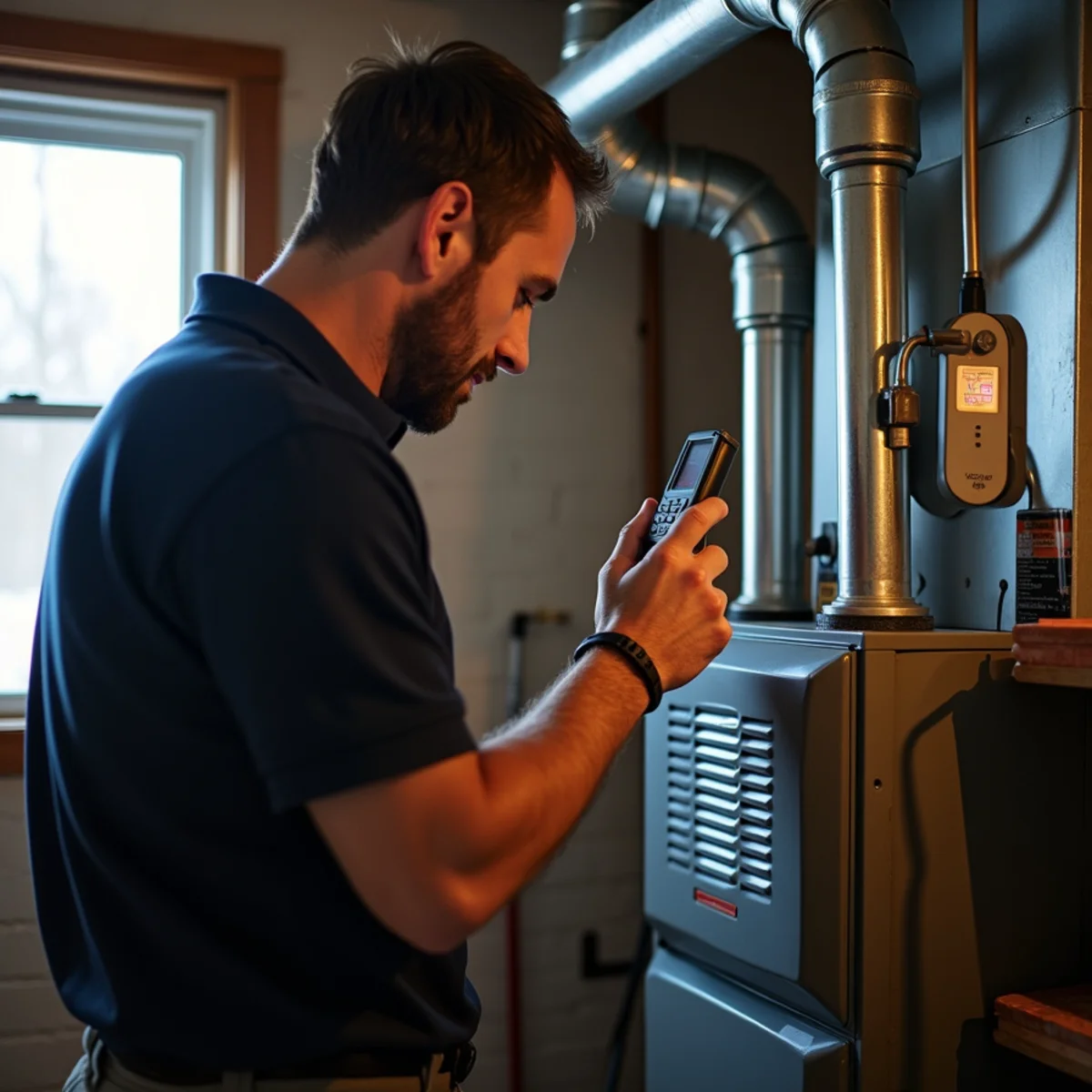
- A combustion analysis in the flue measuring CO, oxygen and efficiency
- Draft testing on natural-draft water heaters and older furnaces
- Visual and camera inspection of the heat exchanger where accessible
- Checking vent pipe slope, joints, terminations and chimney liner condition
Combustion analysis is the step many companies skip, and it is the one that finds problems a flashlight will not. We run it on every furnace we service. A typical scenario in Moraine or elsewhere around Montgomery County is an older furnace that looks tidy but shows elevated CO in the flue from a dirty burner or a hairline crack.
After the all-clear
Do not run the furnace again until the cause is found and fixed. Sometimes the answer is a cleaned burner or a reconnected flue. Sometimes it is a cracked heat exchanger, and then a heating system repair or replacement conversation is needed. Either way, you should get a written explanation of what was measured and what was done.
If your alarm has sounded and responders have cleared the house, call our Miamisburg office. We will test the furnace, venting and CO levels and tell you plainly whether it is safe to use.
Tracking down the source: every CO producer in the house, and how to stay protected
When an alarm goes off near the furnace, it is natural to focus there. A thorough follow-up looks at every fuel-burning appliance and every way exhaust can find its way indoors. The table below is the checklist our technicians carry into a house after the fire department has cleared it, along with the clue that usually points to each source.
Carbon monoxide sources in a typical Montgomery County home
| Source | How it produces CO indoors | Common clue |
|---|---|---|
| Gas furnace | Cracked heat exchanger, fouled burners, a disconnected flue | Alarm sounds during long heating cycles |
| Natural-draft water heater | Stalled draft in an oversized chimney, spillage at the draft hood | Alarm after showers or laundry, even in mild weather |
| Gas range or oven | Poorly adjusted burners, self-clean cycles, use as a heater | Alarm in or near the kitchen while cooking |
| Gas dryer | Lint-blocked or crushed vent pushing exhaust back | Laundry area smells musty-hot, clothes take longer to dry |
| Attached garage | Cars, snowblowers or mowers running, exhaust seeping through the shared wall or door | Alarm on cold mornings after warming up a car |
| Portable generator | Exhaust drawn in through windows, doors or vents | Alarm during a power outage |
| Fireplace or gas logs | Closed damper, blocked chimney, poor draft | Alarm on the first fire of the season |
Many older houses in Dayton, West Carrollton and Moraine have several of these in play at once, so we test with the furnace, water heater and dryer all running together. That worst-case condition is when a weak chimney draft gives up.
Common beliefs about CO, and what is actually true
- “I would smell it.” Carbon monoxide has no odor. The smell people notice near a furnace is usually other combustion byproducts or dust burning off, and it proves nothing either way.
- “New furnaces cannot make CO.” Any appliance burning gas can produce it if the flame, gas pressure or venting is wrong, including a high-efficiency unit with a sagging or cracked PVC vent.
- “The alarm stopped, so the problem is gone.” The source remains until someone fixes it; the concentration simply dropped for the moment.
- “One alarm in the hallway is enough.” Sleeping areas and each level of the home need coverage, because CO from the basement can build up upstairs before a single hallway unit reacts.
- “A yellow flame or a little soot is only cosmetic.” Yellow flames, soot on the cabinet and rust flakes on burners are all signs the burner is not getting clean combustion.
Step by step, from the first beep to a safe restart
- Get everyone, including pets, outside or to fresh air right away.
- Call 911 or the fire department from outside, and let your gas utility know if a gas appliance is suspected.
- Account for everyone; do not go back in for belongings or to hunt for the source.
- Seek medical care for anyone with symptoms and mention carbon monoxide to the staff.
- Re-enter only when responders say the air is clear, and leave gas appliances off.
- Have a technician perform combustion analysis, draft testing and a venting inspection before relighting anything.
- Replace or relocate alarms as needed and add a low-level monitor near bedrooms.
Keeping the alarms themselves reliable
Press the test button on every CO alarm once a month, and replace batteries on the schedule printed on the unit. Sealed ten-year models remove the battery chore but still expire. If you rent, a number of Ohio cities put alarm installation on the landlord, but the rules differ from one city to the next, so ask your landlord or local housing office what applies to your unit.
An alarm is the last line of defense. The first line is a furnace and venting system that is checked every year, which is why our fall furnace tune-up checklist includes combustion testing rather than a visual once-over. Homes with health-sensitive occupants may also benefit from our broader indoor air quality services, which cover ventilation and humidity along with CO monitoring.
From our technicians
What our combustion analyzer turns up after a CO call
The furnace gets blamed first, but when we follow up after a fire department all-clear, the water heater turns out to be the source more often than people expect. The classic setup in an older Montgomery County house is a natural-draft water heater venting alone into a big masonry chimney after a newer high-efficiency furnace moved to its own PVC. The flue gas cools before it can rise, the draft stalls, and exhaust spills out of the draft hood. A smoke pencil or mirror at the hood shows it in seconds.
On the furnace itself, the problems we find most are a flue pipe that slipped apart at a joint, burners fouled with rust flakes dropping from a deteriorating heat exchanger, and a flame that shifts or rolls when the blower kicks on. That last one is a strong hint of a crack, because blower air is pushing through the metal into the burner area.
The biggest homeowner mistake is pulling the batteries or hitting silence and going back to bed. The second is trusting that a furnace running normally is burning safely. Plenty of units that heat the house fine are producing CO in the flue that only an analyzer will read.
We give you the actual numbers from the flue and the living space, explain what they mean, and if something is unsafe, we tag it and say so plainly. No one should run a furnace on a guess.
Want a technician to take a look?
Comfort Air Solutions serves Miamisburg, Dayton and the Miami Valley — 24/7 emergency service.
- 4.8★ · 32 Google reviews
- 25+ years’ experience
- Written options before work
- Factory-Authorized Bryant® Dealer